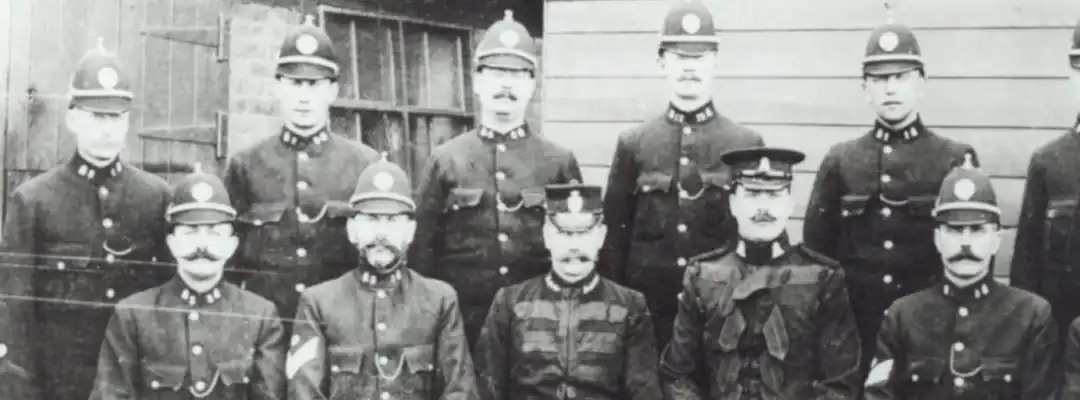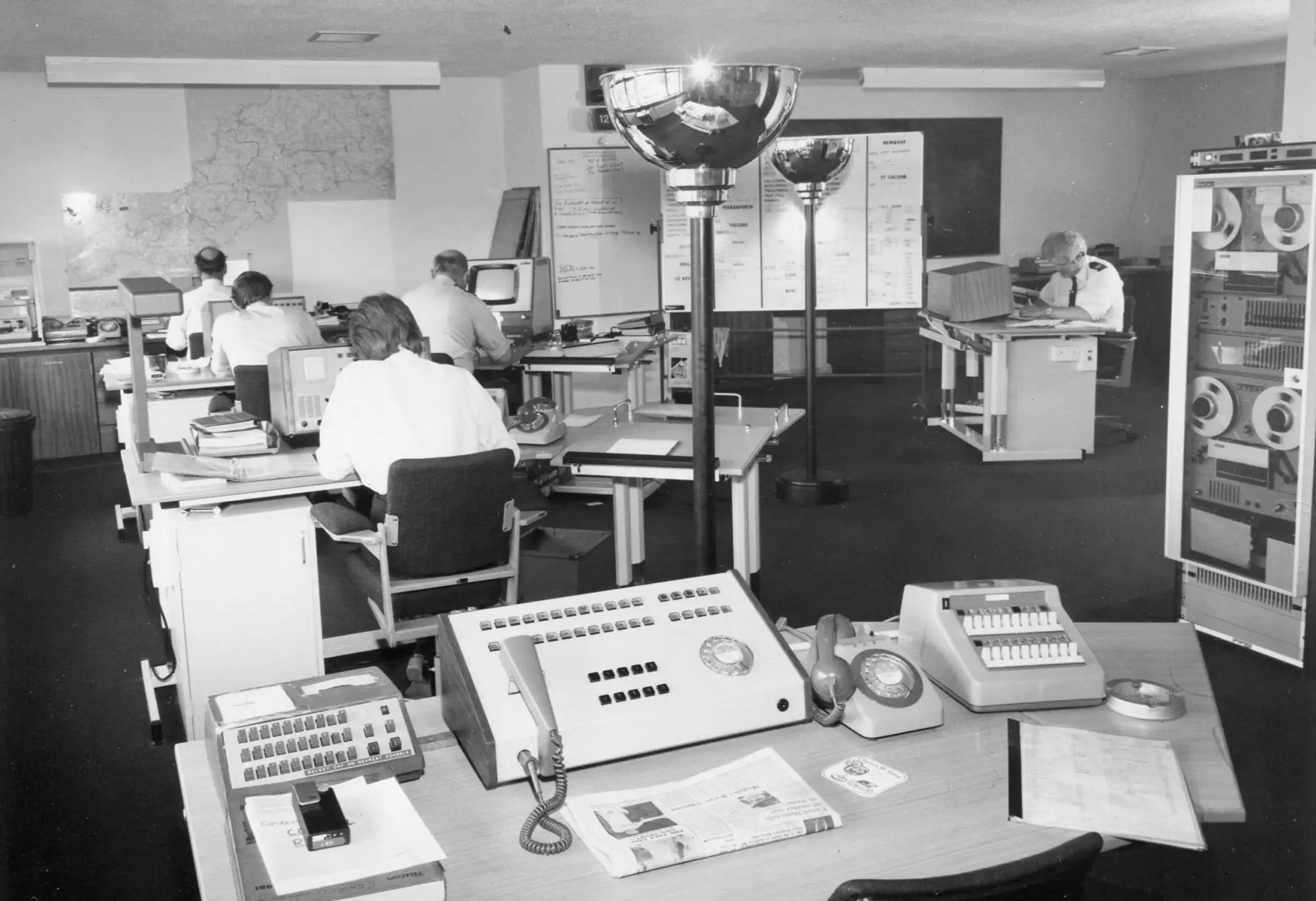

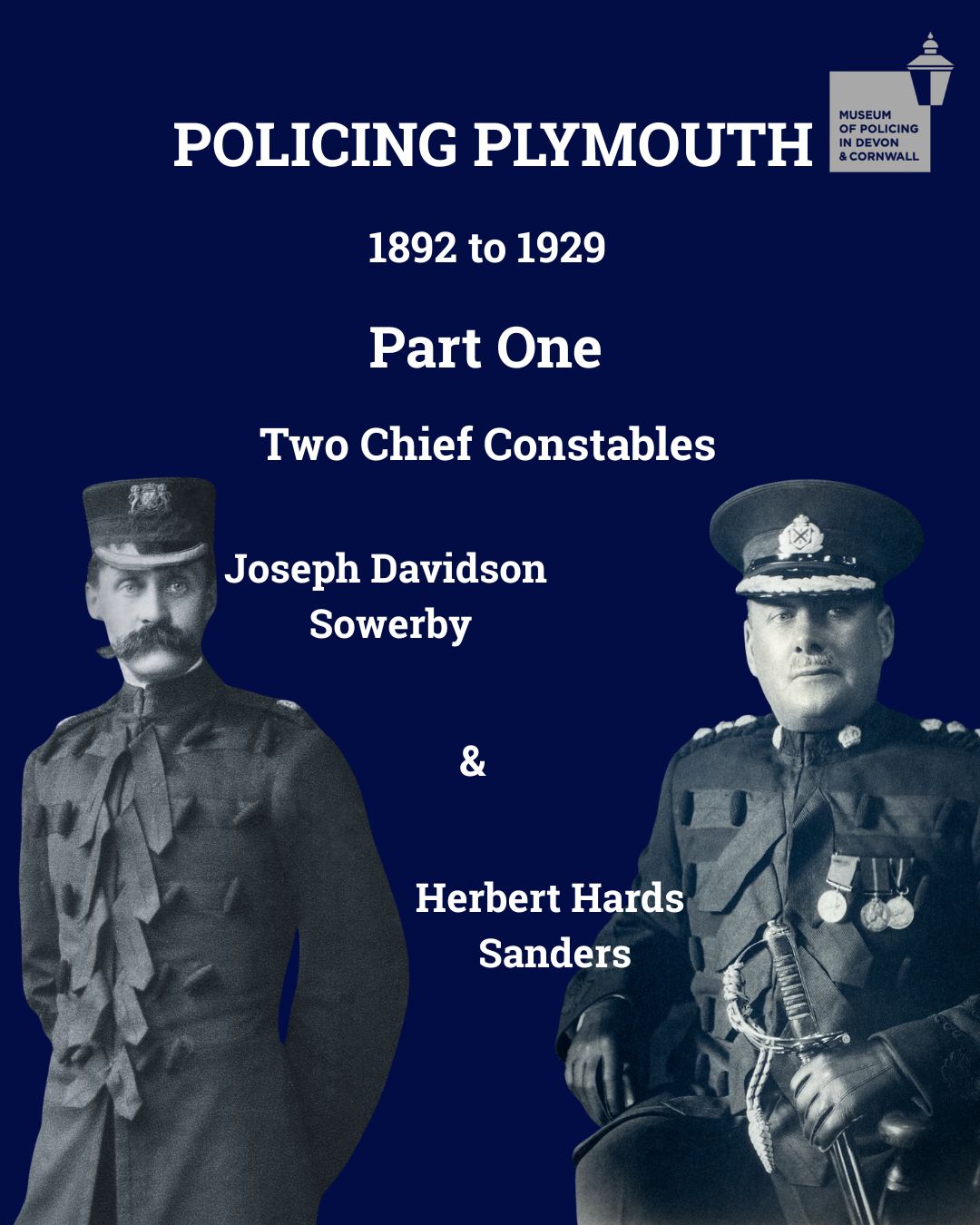
Back in May the Museum of Policing held an exhibition in Royal William Yard covering policing in Plymouth covering around 37 years and the tenure of two great Chief Constables. An excerpt of the same exhibition was brought to Tavistock Guildhall Heritage Centre in early July and will close on 30th July.
For those who won’t have been able to see the exhibition at either venue, we give you a flavour of Policing Plymouth 1892 to 1929.
In this first of two parts, we cover the tenure of Joseph Davidson Sowerby 1892 to 1917.
Plymouth Borough Police came into being in 1836 and struggled for some time to become in any way effective before Superintendent Frederick Wreford announced his intention to retire after 26 years.
The Youngest Chief Constable Ever
Born in 1863 in Everton, Liverpool, Joseph Davidson Sowerby’s father was a currier. The family moved to Leeds when he was 18 and he joined the Leeds City Police in the same year, as a Clerk, but immediately began to climb the ranks.
He’s described in the Leeds City Police Applicants Book as “5 feet 10 inches tall, grey eyes, brown hair, fresh complexion, born Everton, recommended by Percy Middleton Esq. of Leeds”.
He was promoted repeatedly, and within three years rose to gain the rank of First Class Inspector, and by 1886 was promoted again to Chief Inspector. Leeds Watch Committee noted that they had selected him over other candidates with longer service ‘in testimony of his ability and devotion to his duties’.
In 1892 Sowerby was ready for more responsibility and when the Chief Constable of Plymouth Borough Police position became available, following the unexpected death of Frederick Wreford, he was the successful candidate at just 29 years old (See photo Fig 1)
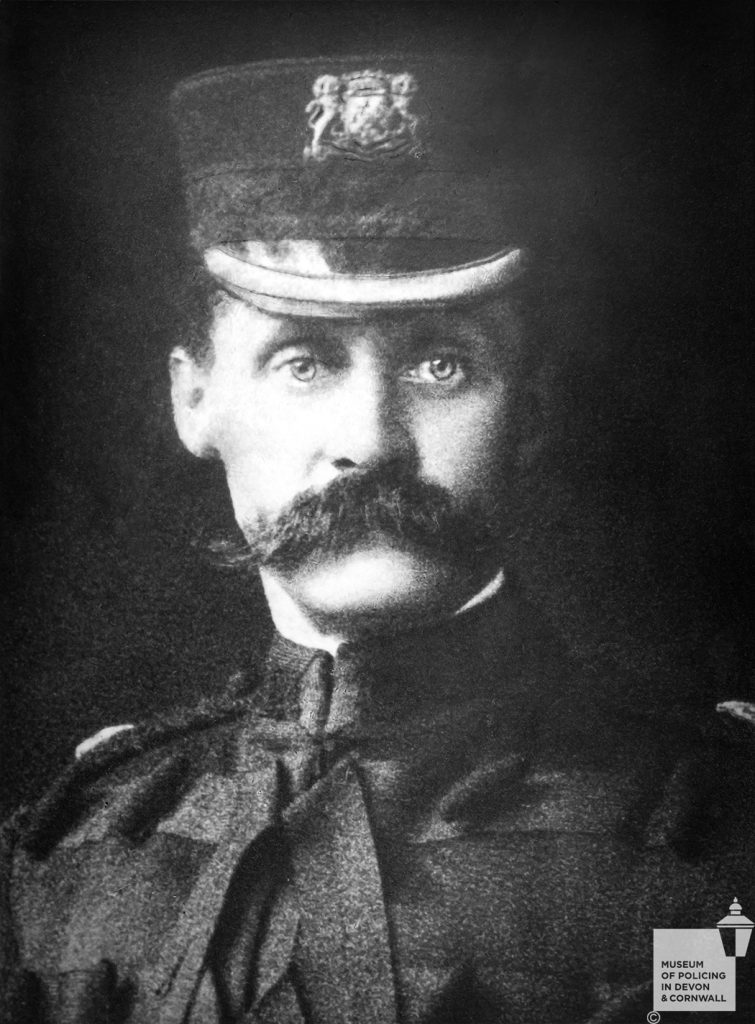
He was sworn in as Chief Constable and Chief Fire Officer of the Plymouth Fire Brigade on a salary of £300 a year.
Arriving at Plymouth’ Catherine Street Police Station, Chief Constable Sowerby found that the force’s morale was low and they were poorly equipped, he immediately set about improving both, believing that a happy, well-paid police would perform better. He went to the Watch Committee to request and was granted enough oil lamps and handcuffs for each constable. He also scrapped an archaic general order that constables had to pay a shilling a week from their wages for insurance of their uniform, ‘for fear he might run away’ with it! He back paid this change allowing officers who had paid it to reclaim the fee, and in doing so handed back a total of about £500.
Sowerby demanded discipline from his men but was also generous, rewarding good work with gifts. When officers retired he was known to have given gifts of furniture or silverware. He ensured that his officers had their day off each month and always received their holiday time, all while pursuing a crackdown on Plymouth’s crime.
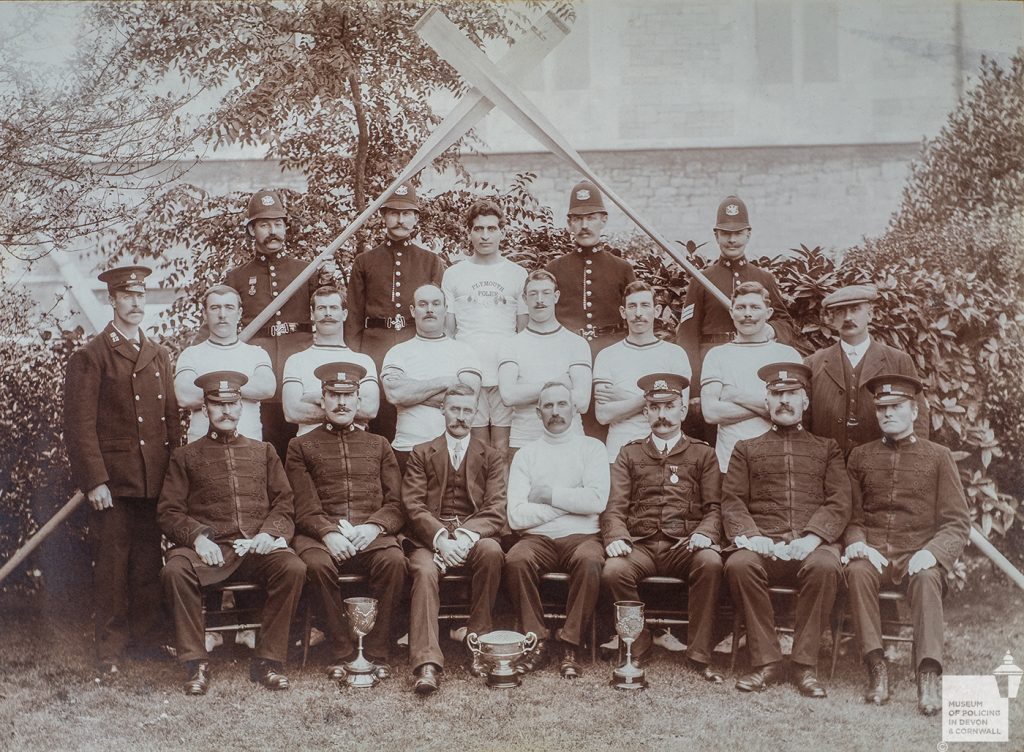
He set up a number of police teams in all sorts of sports from rowing (see Fig 2) to cricket believing it would help the men to be fitter officers, better as a team, and crucially avoid the perils of alcohol.
Alcohol, Gambling & Immorality
Chief Sowerby believed in taking a firm policy against all crime, an early form of “zero tolerance” policing! He had come from Leeds City Police which followed a similar policy against drunkenness, he immediately ordered his Constables to fill the Magistrates’ courts and petty sessions with charges of alcohol related and licensing offences. Alcohol fuelled fights and disorderly behaviour were all too common and hundreds were prosecuted in those first few years.
He personally visited over 300 licenced traders, notably once visiting 40 premises in one day, with a message that they must behave lawfully, avoiding disorderly behaviour and other vices that went along with it. Unsurprisingly, the local licensees were not happy about themselves and their customers being continually prosecuted.
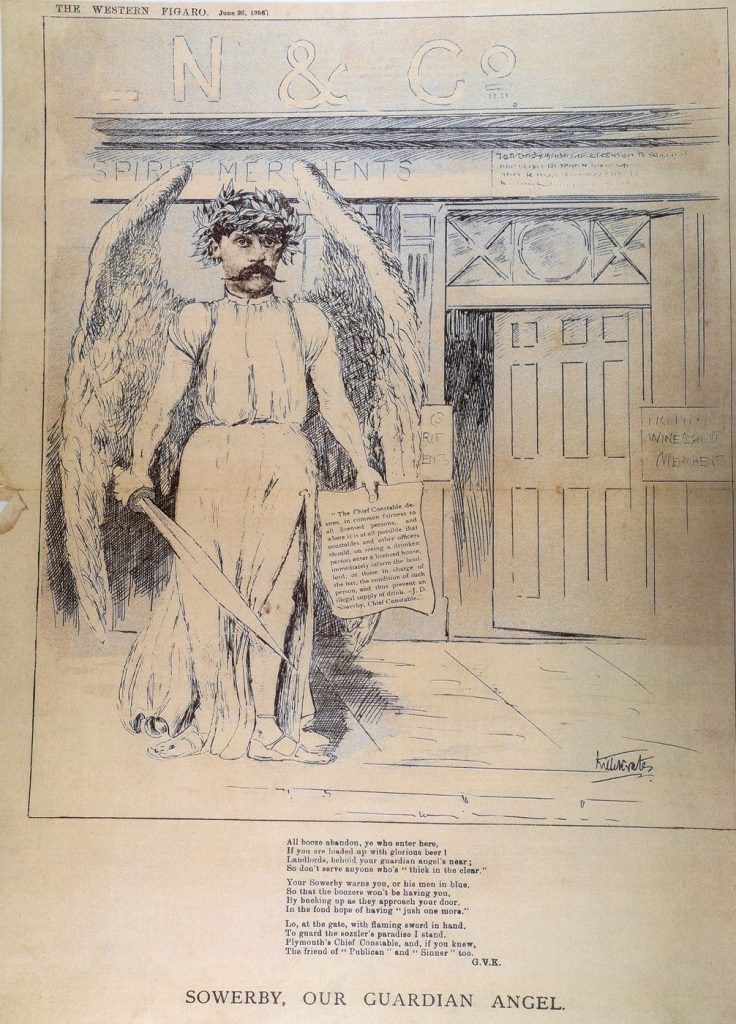
The press never missed an opportunity to poke fun at Sowerby at every given opportunity (Fig 3) and he kept all of these interesting artworks which we are lucky enough to have in our archive. Perhaps he could see that he was having an effect, he was utterly determined and did have a good sense of humour. However, he could be pleased that the conviction rate for drunkenness was now one of the lowest nationally and the average population per licensed premises one of the highest. Sowerby was summonsed to appear as a witness to the Royal Commission and attributed these successes to the ‘improved social condition of the people’ brought about by the police supervision of the public houses and ‘enlightened attitudes of the young’.
Sowerby was of the opinion that if everyday crime was tackled then all crime would be reduced. As a result he took a similar approach to gambling as he had to alcohol, believing that it was to be tackled in all its forms at all levels of society. Undercover work at various illegal gambling establishments brought about several prosecutions but the Watch Committee (local overseers) were deeply unhappy at the cost of these prosecutions.
Immoral behaviour or prostitution was, for many women, the only way to sustain their family which was a deeply troubling situation. In one sad case, a 26-year-old widow living at Central Road with five children from her husband’s first marriage pleaded, ‘What can I do for a living? I can’t help myself.’ Sowerby admitted, ‘It was a pitiful case’.
The magistrate agreed but was lenient as the widow informed him that she had managed to find work in a local laundry.
Firebobbies of Plymouth
When Joseph Sowerby became Chief Constable in 1892, he automatically became Captain of the Police Fire Brigade. Most of the Police Firemen were from Plymouth Borough Police but some were from Devon Constabulary, such as Joseph Stoneman, who was stationed at Laira. The horse drawn ‘fire engines’ were quite small so putting out a large fire was extremely difficult and dangerous. They had very little protective equipment, brass helmets were the only major difference from the usual police uniform of the time.
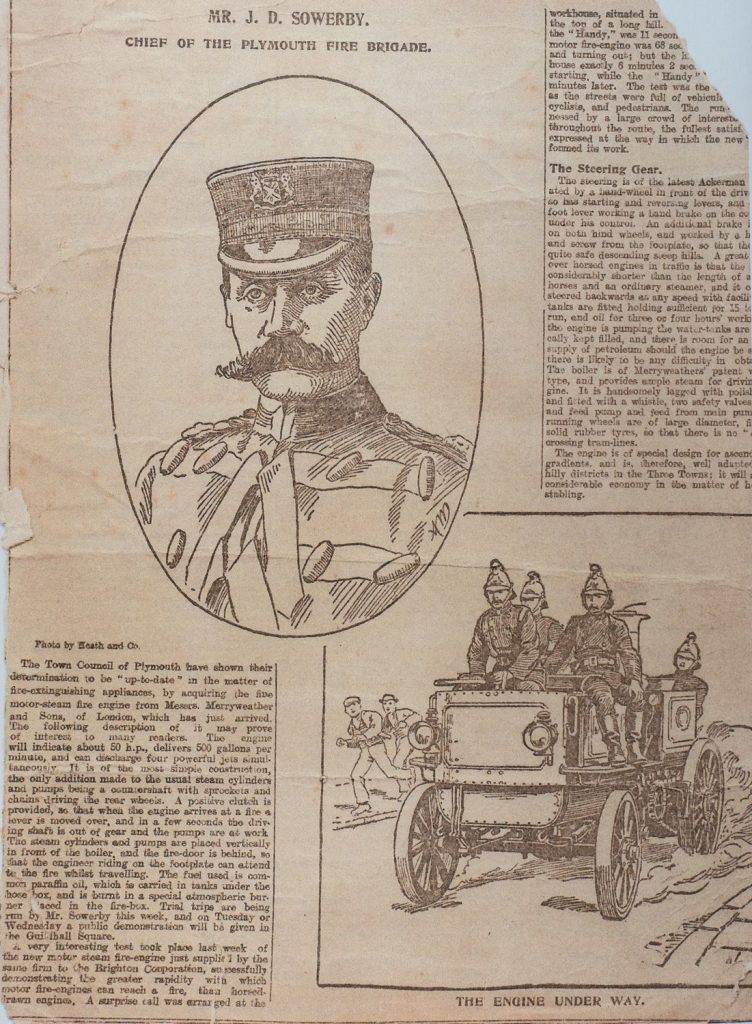
Fire Captain Sowerby ensured his men were well trained and was keen on public fire safety education including promoting the use of fire escapes in hotels etc. Eventually, a motorised Merryweather vehicle was purchased around 1903 (Fig 4), it ran on paraffin and could even move backwards!
A serious fire broke out at the Plymouth Workhouse, and here is an edited excerpt of the report from the North Devon Journal of 11th July 1907: The main portion of Plymouth Workhouse was completely destroyed by fire early on Friday morning and the inmates were placed in grave peril. The outbreak, which was discovered about 2am, originated in a store containing a large quantity of clothes and situated above the upper ward on the men’s side of the building. The structure is an old one and the fire spread with amazing rapidity, and before the fire brigade could be summoned, the roof was well alight throughout the length of the building with 250 inmates sleeping inside. The inmates were roused and as many as possible were ushered out of the burning building.
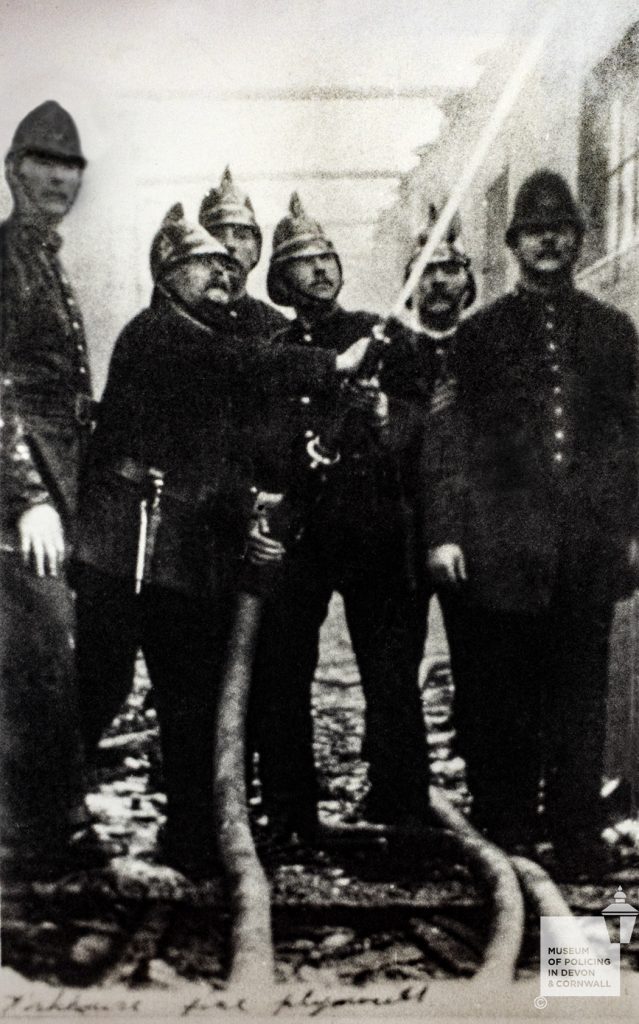
The police and firemen arrived and began to fight the fire (Fig 5) and carrying many of the infirm inmates out of danger. Almost the last to leave was an old bedridden woman who was carried out of the burning building by Chief Constable Sowerby himself. It was with great difficulty that she could be persuaded to leave her bed and she had practically to be torn from the burning building. The fire burnt furiously for a couple of hours and the main block was completely gutted before it was got under control.
It’s implied that Sowerby attended every fire until 1910 as the Watch Committee negotiations of that year noted that he was no longer required to attend all fires, only those of a ‘serious nature’.
The Mrs Pankhurst Affair
In April 1913 Emmeline Pankhurst was sentenced to 3 years imprisonment for inciting a fire at Lloyd-George’s golf villa at Walton on the Hill. She had been released and re-arrested 4 times under the “Cat and Mouse Act” but a lecture tour in the USA broke the conditions of her licence.
Chief Constable Sowerby was ordered to arrest Mrs Pankhurst on her arrival in Plymouth. He was concerned that there was a very real risk of violent disorder breaking out especially as thousands of suffragettes (the militant arm of women’s suffrage) and suffrage supporters had arrived in Plymouth to greet and protect their heroine.
On the 4th of December a large crowd, gathered at Great Western Docks where Mrs Pankhurst’s ship the RMS Majestic, was due to dock. Other suffragettes patrolled Plymouth all ready to help protect Mrs Pankhurst. However, the Majestic anchored at Cawsand Bay, Chief Constable Sowerby, DI Hitchcock, 2 police officers and a Wardress sailed from Bull Point to meet her. As they approached, a small tug, with Mrs Pankhurst’s supporters on board, tried to get ahead of them shouting the warning “the cats are coming”, 2 Royal Navy ships quickly moved in to position to block the press and any further supporters. The police team boarded the Majestic and Chief Sowerby requested that Mrs Pankhurst meet him in the Purser’s office, she refused, so instead he arrested her in full view of the deck.
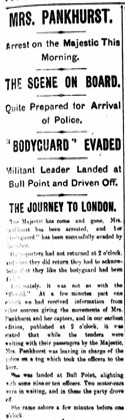
Fig 6: Mrs Pankhurst Arrested
The police team, the now re-arrested Mrs Pankhurst (Fig 6), and a Mrs Rheta Child Dorr (who had reputedly sewn the earnings of the US appearances into her dress to prevent confiscation) returned to Bull Point where a motor car was waiting to take Mrs Pankhurst across Dartmoor to prison in Exeter Gaol.
Sowerby’s plan had bypassed the bodyguard and supporters to ensure the arrest and avoided violence, a very real possibility that day.
Woman Police Matron, The Great War & Patrolwomen
Joseph Davidson Sowerby, was one of the first in the Southwest to appoint a Police Matron, a civilian role whose job was to look after the women prisoners. The first, Mrs Searle, served for 27 years from 1899 to 1926.
In 1914 as the Great War loomed, Devonport and Stonehouse were amalgamated into Plymouth Borough Police.
During the Great War, Plymouth and Chief Sowerby welcomed the sudden appearance of the National Union of Women Workers (NUWWO) Patrolwomen, on to their streets in 1917. Born from the suffrage movement, this was a national effort to assimilate women into policing. They wore smart uniforms and patrolled the streets between 6pm and 10:30pm and were mostly concerned with ensuring the moral well-being of young women, especially those working late as part of the war effort.
Retirement of an English Gentleman
In 1917 Chief Constable Sowerby retired, leaving a well-respected and efficient police force and fire brigade despite being several years into the Great War. An outpouring of affection from many people including the press (Fig 7 from our archive) who were actually very fond of this exemplary and devoted Chief Constable.
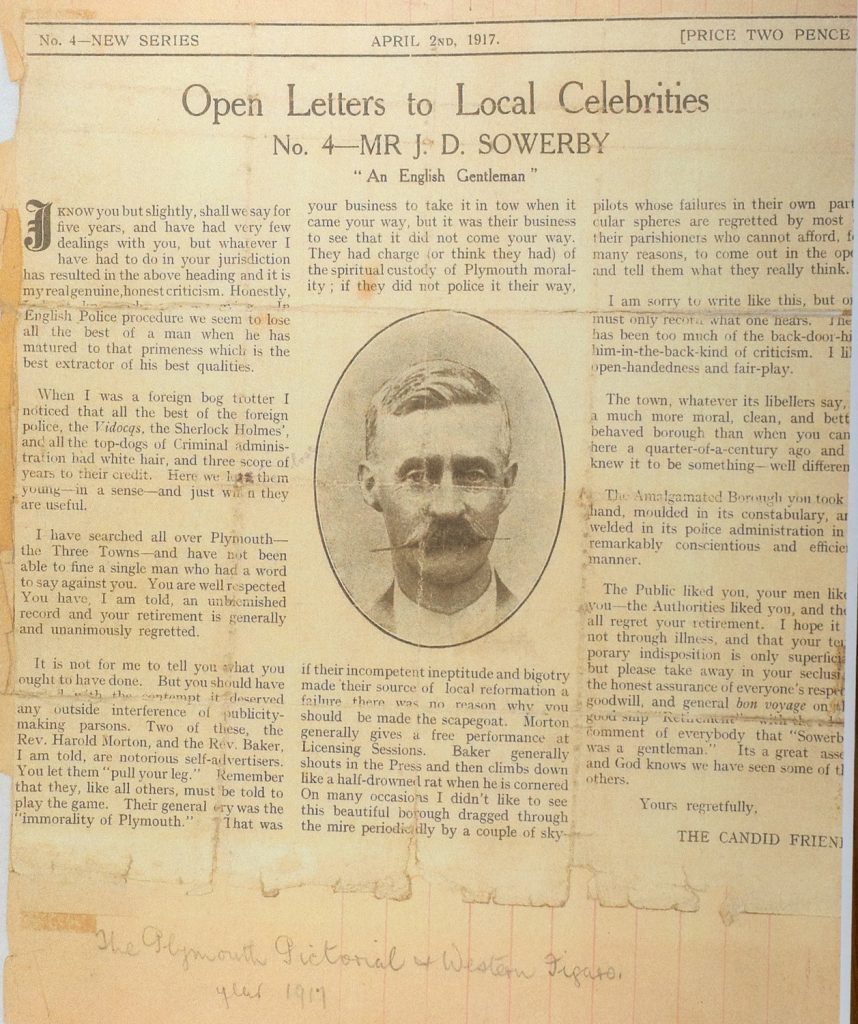
Joseph Davidson Sowerby was succeeded as Chief Constable by Herbert Hards Sanders. Part Two will cover his story soon.
We are very grateful to the following for their contributions to the exhibition/s and this article:
Professor Kim Stevenson Rob Giles (Timelock Productions)
Royal William Yard Dr Iain Channing
Mark Rothwell Ralph Delbridge
Cyberheritage Plymouth History
The Sowerby family descendants Tavistock Guildhall Heritage Centre
Staff and Volunteers at Museum of Policing in Devon & Cornwall